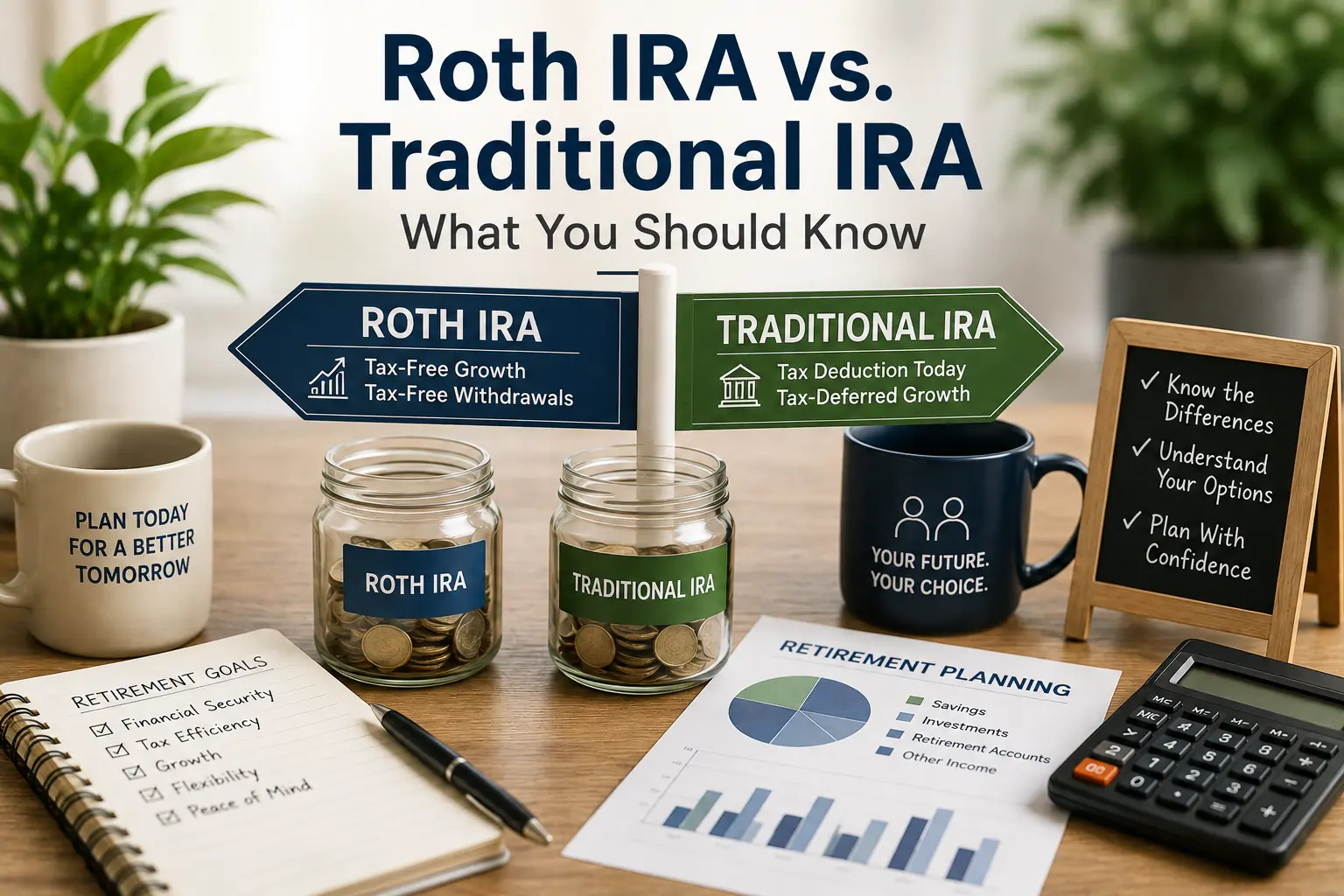

Federal employees have several retirement savings options to consider, including the Thrift Savings Plan (TSP), Traditional IRAs, and Roth IRAs. Understanding how Traditional and Roth IRAs differ can help you better understand the tax considerations that may apply to your retirement savings strategy.
For federal employees, these accounts may also need to be considered alongside FERS or CSRS retirement income, Social Security, TSP savings, and other financial resources.
A Traditional IRA is a tax-advantaged retirement account that may allow eligible individuals to deduct contributions from taxable income, depending on factors such as income, filing status, and participation in an employer-sponsored retirement plan.
Generally, the tax treatment works like this:
Contribution → Potential Tax Deduction → Tax-Deferred Growth → Generally Taxable Withdrawals
Traditional IRA distributions are generally included in taxable income when received, although certain exceptions and rules may apply.
Whether a contribution is deductible depends on your individual circumstances and applicable IRS rules.
A Roth IRA generally provides a different tax treatment.
The basic structure is:
Contribution → No Tax Deduction → Potential Tax-Free Qualified Withdrawal
Roth IRA contributions are generally made with after-tax dollars and are not deductible. However, qualified distributions can generally be tax-free when applicable requirements are satisfied.
Roth IRA eligibility and contribution rules can also be affected by income and other IRS requirements.
A Traditional IRA may be worth evaluating if:
The potential deductibility of Traditional IRA contributions can depend on your income, filing status, and whether you or your spouse participates in an employer-sponsored retirement plan.
For federal employees, these considerations may also need to be evaluated alongside TSP contributions and other retirement benefits.
A Roth IRA may be worth evaluating if:
Qualified Roth IRA distributions generally require the applicable five-year rule to be satisfied along with a qualifying condition, such as reaching age 59½. Other rules and exceptions can apply.
A common question is:
“Which IRA gives me the lowest tax bill today?”
A broader question may be:
“Which tax treatment fits my overall retirement strategy?”
Your current and expected future tax situation, FERS or CSRS retirement income, TSP balance, Social Security benefits, other retirement accounts, and planned withdrawals may all be relevant when evaluating Traditional and Roth IRA options.
There is no universal answer that applies to every federal employee.
Yes. In many situations, an individual can have both a Traditional IRA and a Roth IRA.
However, the annual IRA contribution limit generally applies to your combined contributions across Traditional and Roth IRAs rather than providing a separate full limit for each account.
For 2026, the standard combined IRA contribution limit is $7,500. Individuals age 50 or older may generally be eligible for an additional $1,100 catch-up contribution, bringing the total to $8,600, subject to applicable IRS rules and eligibility requirements.
Having both types of accounts may provide additional tax-planning flexibility, but the appropriate approach depends on your individual circumstances.
Some investors consider converting money from a Traditional IRA to a Roth IRA.
A Roth conversion generally involves moving eligible funds from a Traditional IRA or another qualifying retirement account into a Roth IRA. The taxable amount of a conversion may generally be included in gross income for the year of the conversion, subject to applicable rules.
Because a conversion can affect your taxable income and overall tax situation, it is important to evaluate the potential consequences before making a decision.
Federal employees may also want to consider how a Roth conversion could interact with other retirement income sources, including a FERS or CSRS pension, TSP withdrawals, and Social Security.
A qualified tax or financial professional can help you evaluate the tax considerations that may apply to your circumstances.
There isn’t one IRA that is automatically better for everyone.
Factors that may be relevant include:
The objective isn’t simply to select the account with the most attractive tax treatment today. It may be more useful to consider how different account types could work together within your broader retirement income strategy.
Traditional and Roth IRAs can both be useful retirement savings vehicles, but they generally provide their tax benefits in different ways.
A Traditional IRA may provide a potential tax deduction for eligible contributions, with generally taxable withdrawals later. A Roth IRA generally does not provide a deduction for contributions, but qualified withdrawals can generally be tax-free.
For federal employees, comparing these options alongside FERS or CSRS benefits, TSP savings, Social Security, taxes, and other retirement resources may provide a more complete picture of your retirement planning considerations.
Understanding the differences can help you ask informed questions and determine which factors may deserve further consideration.
If you are evaluating Traditional IRA contributions, Roth IRA contributions, or a Roth conversion, Federal Employee Advisor Network can help connect you with an independent, licensed financial professional who may be familiar with retirement planning considerations for federal employees.
The professional you are connected with can discuss your individual circumstances, goals, and available options directly with you.
Federal Employee Advisor Network is a connection service and does not itself provide individualized investment, tax, legal, or retirement advice. Information on this website is provided for general educational purposes and should not be considered a personalized recommendation or guarantee of results.
Professionals connected through the network are independent from Federal Employee Advisor Network and are responsible for the services and advice they provide. Before engaging a professional, individuals should review the professional’s qualifications, services, fees, licenses, registrations, and applicable disclosures.
Tax rules and retirement account regulations can change, and individual circumstances vary. Consult an appropriately qualified tax, legal, or financial professional regarding your specific situation.